

If a lace wig looks unnatural at the hairline, the problem is rarely just “not enough plucking.”
In my experience working with wig brands and salons, a natural hairline is usually the result of several details working together: density, shape, knots, lace, ventilation direction, temple design, and fit.
You can bleach the knots heavily and pluck the front very thin, but if the hairline is too straight, the lace does not sit flat, or the hair grows from the lace at the wrong angle, the wig can still look obvious.
That is why I prefer to think of a natural hairline as a design system, not a single technique.

1. Start With Density Transition, Not Just a Lower Density
One of the first things I look at is the transition from the very front of the hairline into the main body of the wig.
A natural human hairline is rarely the same density from the first row backward.
Normally, the very front looks lighter. The density then gradually builds until it reaches the normal density of the wig.
That is the effect we try to reproduce.
The mistake I sometimes see is treating “natural hairline” as meaning “pluck more hair from the front.”
That can go too far.
The objective is not to make the front extremely thin. It is to create a believable transition.
There is also no single percentage that works for every wig. A good result is usually judged visually rather than by following a rigid density formula.
2. A Natural Hairline Should Not Look Drawn With a Ruler
Perfect symmetry can actually make a lace wig look less natural.
Real hairlines normally have slight variations in height, density, temple shape, and growth pattern.
For that reason, I generally prefer some controlled irregularity rather than one perfectly straight line.
Depending on the product, that may include:
- a slightly irregular front shape
- subtle temple recession
- a soft widow's peak
- a small amount of fine baby hair
The important word here is controlled.
Adding more baby hair, more recession, and more unevenness does not automatically make a wig more realistic.
Natural irregularity should still look intentional.
For private-label brands, I also do not believe every brand needs exactly the same hairline template. Some brands prefer a softer rounded shape. Others want more defined temples or a specific front profile.
That should be part of the product design.
3. Look at the Knots Before Asking for More Bleaching
Visible dark knots are one of the fastest ways to lose the illusion of hair growing directly from the scalp.
That is why bleaching is so commonly discussed.
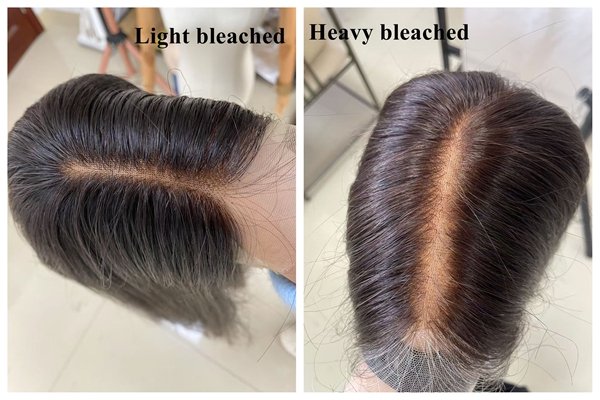
Heavy bleaching can certainly make dark knots less visible, especially on darker hair colors. But there is a trade-off that brands should understand.
The stronger the chemical treatment around the knot, the greater the potential impact on knot strength.
Heavy bleaching can also create unwanted warm, yellow, or reddish tones around the root or lace if the process is pushed too far.
So I do not automatically believe that the heaviest possible bleaching is always the best solution for a premium wig.
For some brands, maximum invisibility is the priority.
For others, especially where customers expect longer wear, durability matters more.
Before increasing bleaching, I would also look at the construction itself:
- How large are the knots?
- What knotting technique is being used?
- Are the knots in the front hairline as fine as they should be?
- Can the visible knots be reduced through better ventilation rather than stronger bleaching?
A small amount of scalp makeup or foundation can also help reduce visible knots during wear without weakening the construction.
The important principle is:
A natural hairline should be engineered before it is bleached.
4. Hair Direction Matters More Than Many Brands Realize
This is one detail that is often missed when comparing samples.
You can have good lace, good plucking, and well-bleached knots, but if the hair comes out of the lace like a row of upright bristles, the front can still look artificial.
Natural hair does not grow from the scalp at one identical angle.
The direction changes across the forehead and especially around the temples.
When I evaluate a hairline, I therefore look at more than how much hair is present.
I also look at how the hair emerges from the lace.
The ventilation direction should allow the front hair to fall naturally rather than forcing the wearer to fight the hairline with styling products.
5. HD Lace Alone Does Not Create an Invisible Hairline
“HD lace” has become one of the most heavily marketed terms in the wig industry.
But the name itself does not guarantee a natural result.
For higher-end wigs, I care more about how the lace actually behaves on skin.
I look at:
- transparency
- softness
- thickness
- how closely it lies against the skin
- whether the color works with the intended customer base
- whether the lace is still practical enough for real wear
A beautiful lace material can still look unnatural if the hairline construction is poor.
At the same time, a well-designed hairline can lose its effect if the lace lifts from the forehead.
So lace quality matters, but it should be evaluated as part of the complete system.
6. Temple Coverage Depends on How the Wig Will Be Styled
The temple and sideburn area is important, but not equally important for every wig.
If a customer normally wears a middle part or side part with the hair falling naturally around the face, the temple area may not be very exposed.
But the situation changes when she wants to:
- tuck the hair behind the ears
- wear the hair away from the face
- create a half-up style
- pull the hair into a low ponytail
At that point, temple coverage becomes much more visible.
This is why I prefer to ask a broader product-development question:
How much styling freedom should this wig provide?
That answer can influence the temple design, lace area, cap construction, and ultimately the cost of the wig.

7. Hairline Placement and Cap Fit Still Matter
A well-made hairline can still look wrong if it sits in the wrong position.
If the wig is pulled too far forward, the forehead proportions may look unnatural.
If it sits too far back, the wearer's own hair or lace edge may become visible.
A poor cap fit can also cause the lace to lift, especially around the temples.
This is particularly important with glueless wigs, where the cap fit, elastic tension, ear tabs, and lace placement all need to work together.
So I separate two issues when evaluating a wig:
Hairline design and hairline fit
You need both.
8. How I Recommend Brands Evaluate a Hairline Sample
A wig sample can look excellent on a mannequin head and very different on a real person.
That is why I recommend evaluating the sample under actual wearing conditions.
| What to Check | What I Look For |
|---|---|
| Front density | Gradual transition from lighter to fuller |
| Hairline shape | Natural variation without looking artificially irregular |
| Knots | Minimal visible dark dots at close range |
| Lace | Thin, flat, and visually unobtrusive on skin |
| Hair direction | Hair leaves the lace at believable angles |
| Temples | Natural when hair is tucked behind the ears |
| Fit | Hairline sits flat without lifting or pulling |
I would also take close-up photos.
Photos often reveal knot visibility, lace edges, or density problems that are easy to miss when looking at the wig casually.
Washing is extremely important when evaluating hair quality, but for the hairline itself, I usually learn more from real-person fitting, close-up photography, and different styling positions.
9. For Brands, Consistency Is the Bigger Challenge
Creating one beautiful sample hairline is not the hardest part.
The harder question is:
Can the manufacturer reproduce it across 20, 50, or 100 wigs?
This is where product development becomes different from simply ordering a sample.
“Make the hairline natural” is too subjective for production.
Once a brand approves the final look, I prefer to turn it into a repeatable reference using:
- an approved physical sample
- close-up reference photos
- agreed hairline shape
- density transition references
- knot and bleaching standard
- temple reference
- QC comparison before shipment
A premium brand does not only need a beautiful prototype.
It needs a hairline that remains recognizable as the same product from one production batch to the next.
Final Thought
When I look at a lace wig hairline, I never judge only the plucking or the bleaching.
I look at how all the elements work together.
Density. Shape. Knots. Ventilation. Lace. Temples. Fit.
That combination is what creates the illusion that the hair is growing naturally from the scalp.
And for a wig brand or salon, there is one more layer:
The goal is not simply to create one natural-looking sample.
The real goal is to create a natural hairline standard that your manufacturer can reproduce consistently.