

Wondering why some high-end investments still end up looking like obvious hairpieces? You buy premium hair, expecting flawless realism, only to find the reflection in the mirror looks stiff, bulky, and artificial. The secret to what makes a human hair wig look natural isn't just about sourcing raw donor hair; it lies in the meticulous details of craftsmanship that mimic Mother Nature herself.
A human hair wig looks natural when it successfully mimics the imperfections of real human hair growth. This requires a graduated, hand-plucked hairline, invisible Swiss HD lace that matches the skin tone, realistic hair density (typically 120% to 130%), and healthy, non-synthetic luster.

Over my years of supplying premium hair systems to luxury salons across Europe, the Middle East, and Australia, I’ve seen countless buyers make the mistake of looking only at the spec sheet. Let's peel back the layers and look at what actually creates that "is that her real hair?" reaction.
Why Doesn't 100% Human Hair Automatically Make a Wig Look Natural?
Many salon owners believe that buying "100% Remy human hair" automatically guarantees a flawless look. However, when the wig arrives, it can still look incredibly fake and wiggy.
Raw human hair is simply the raw material, not the final guarantee of realism. A human hair wig looks natural only when the raw hair is processed with correct density, cuticle alignment, hand-knotted roots, and a scalp-like base.
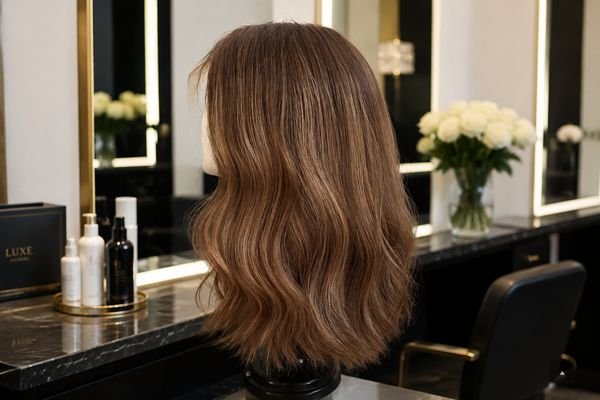
I often tell my clients: a block of premium marble doesn't make a masterpiece; the sculptor does. If you take top-tier European hair but knot it heavily onto a thick, dark monofilament base with 180% density from the very first millimeter, it will look like a helmet.
The Trap of "Too Perfect" Hair
Real human hair has natural imperfections. It has varying thicknesses, subtle color shifts, and a soft, natural luster. Cheaply processed "human hair" is often stripped of its cuticles and coated in heavy silicone to make it shiny. This artificial shine is a dead giveaway under salon lights.
Processing and Cuticle Direction
When we source hair for high-end boutique salons, we ensure the cuticle remains intact and aligned in the same direction. This prevents tangling and allows the hair to move and catch light naturally. Natural light reflection is vastly different from the uniform, glassy glare of chemically treated fibers.
How to Design the Hairline to Make a Human Hair Wig Look Natural?
If a client walks down the street and someone glances at their forehead, that split-second look determines everything. A harsh, straight-cut hairline instantly screams "wig."
The hairline is the ultimate make-or-break factor because it is the most visible transition point between skin and hair. A natural hairline must have a low-density gradient, irregular spacing, and bleached knots to remain completely undetectable.
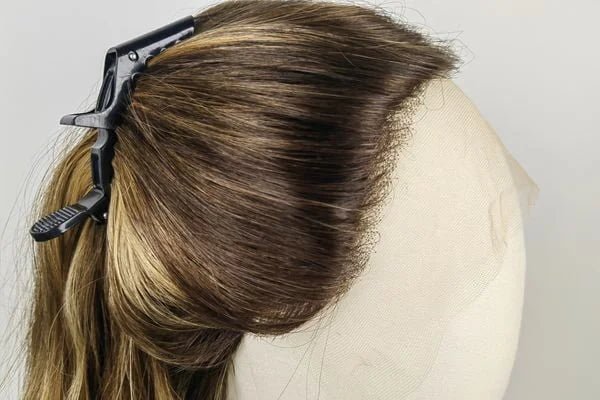
In my decade of manufacturing, I’ve learned that the human eye is incredibly sharp at detecting artificial patterns. If a hairline looks like a solid wall of hair, our brain immediately flags it.
The Anatomy of a Natural Hairline
To make a human hair wig look natural, the hairline must follow a three-stage transition:
- The Baby Hair Zone: Extremely fine, single-strand hairs spaced widely apart.
- The Transition Zone: Gradual increase in density using single knots.
- The High-Density Zone: Where the full volume of the wig begins, further back from the forehead.
Standard Factory Hairline vs. Master-Crafted Hairline
| Feature | Standard Factory Wig | Master-Crafted Premium Wig |
|---|---|---|
| Density Profile | Flat 130% from the edge | Graduated (50% to 130%) |
| Knotting Style | Double knots on the edge | Single, ultra-fine knots |
| Knot Color | Dark, visible dots | Bleached knots |
| Shape | Perfect, symmetrical arc | Irregular, natural micro-waves |
What Are the Six Key Factors that Make a Human Hair Wig Look Natural?
Trying to evaluate a wig without a checklist leads to inconsistent purchases and unhappy salon clients. You need a systematic way to judge true realism.
To make a human hair wig look natural, you must master five critical dimensions: the graduated hairline, non-synthetic luster, realistic parting space, proportional hair density, and naturally tapered hair ends.
Let's break down these five pillars in detail. When I consult for premium hair replacement clinics in London or Beverly Hills, these are the non-negotiables we review for every single piece.
1. The Hairline & 2. The Luster
We've discussed the hairline, but luster is equally vital. High-end human hair has a healthy, satin sheen, not a glassy, plastic gloss. If a wig is too shiny under indoor lighting, it looks synthetic, even if it is 100% human hair.
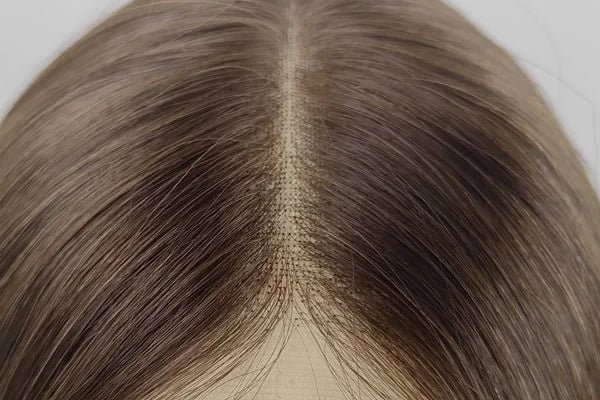
3. The Parting (The Scalp Illusion)
When someone looks down at your head, they see the parting. A natural part must look like real skin. This is achieved using high-quality Swiss lace or a silk-top base where the knots are completely hidden, mimicking hair emerging directly from follicles.
4. Proportional Hair Density
More hair is not better. Many cheap manufacturers throw 150% or 180% density at a wig to hide poor construction. High-end natural wigs often use a realistic 120% to 130% density, carefully distributed so the wig lies flat and moves organically.
5. Natural Hair Ends
Real hair has a history; it has been cut, weathered, and layered. A wig with blunt, perfectly uniform ends looks like a synthetic curtain. We hand-taper the ends of our premium human hair wigs so they swing and sway naturally.
Where to Spend Your Budget to Make a Human Hair Wig Look Natural?
With limited budgets, salon owners and brand buyers often struggle with where to allocate their funds. Do you pay for fancy packaging, excessive length, or density?
When budget is limited, always prioritize the lace quality, hairline craftsmanship, and hair source over density and length. An ultra-natural 12-inch wig always outperforms a bulky, unnatural 24-inch wig.
I always tell my B2B clients: "Don't buy weight, buy workmanship." If you want to make a human hair wig look natural, you must invest in the foundational elements that cannot be faked.
The Value of Swiss HD Lace
The base material is the foundation. Premium HD lace melts into the skin, making the transition invisible under any lighting. If you skimp here and buy cheap, thick medium-brown lace, no amount of styling will save the look.
The Cost of Craftsmanship
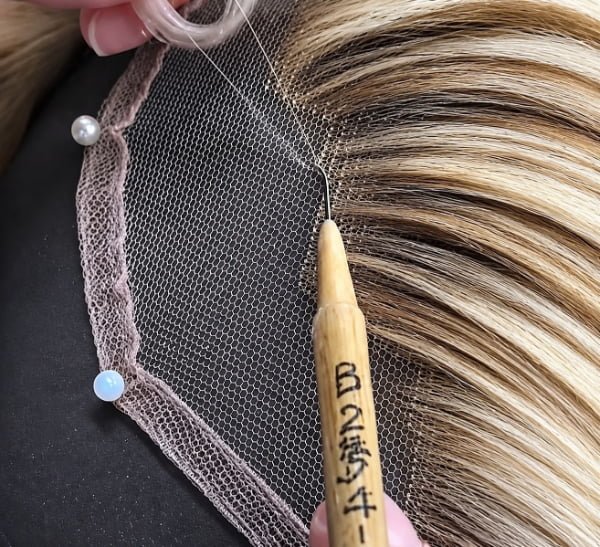
Hand-tying a single wig can take a skilled artisan up to 40 hours of intensive labor. This is where the money goes. You are paying for their eye, their precision, and their ability to tie knots so small they are virtually invisible. Elegant, minimalist packaging is nice, but it doesn't help your client feel confident when they walk out of your salon. Focus your dollars on what stays on their head.
Why Do Premium Wigs Cost More to Make a Human Hair Wig Look Natural?
It can be incredibly frustrating to explain to your finance department or your retail customers why one wig costs $300 more than another when they look similar on a website.
The extra $300 for a premium wig pays for invisible hand-knotting, custom hairline customization, cuticle-aligned virgin hair, and ultra-thin Swiss lace. You are buying the confidence of knowing the wig is completely undetectable.
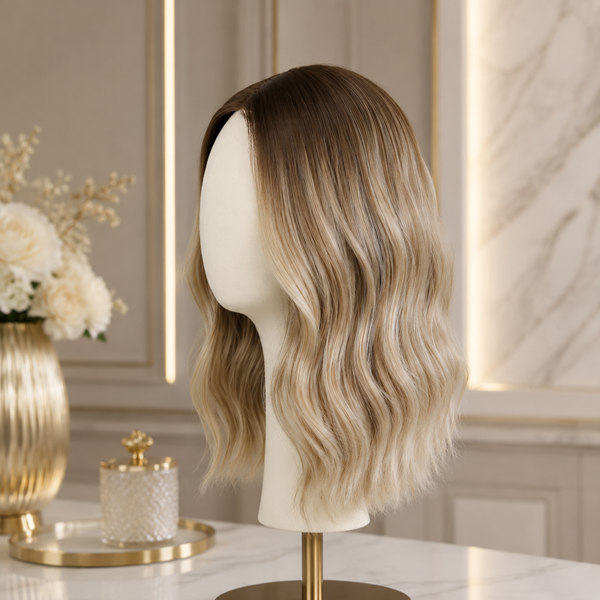
Let's talk business. In the high-end medical and salon space, a client isn't just buying hair; they are buying their identity back.
The Hidden Labor of Invisible Knots
In a standard factory wig, knots are tied quickly, resulting in double knots with several strands of hair in each knot that look like black pepper sprinkled on the scalp. In our premium collections, we use only one strand of hair in single knot on the front hairline, which are then meticulously bleached and sealed. This labor-intensive process is what adds to the cost but removes any trace of artificiality.
"True luxury is invisible. When you wear a premium wig, the craft lies in what people cannot see."
When a client pays that premium, they are paying for the freedom to wind-blow their hair, to pull it back into a ponytail, and to stand under bright office fluorescent lights without a single worry. The ultimate goal of a high-end wig is not to be a great piece of hairpiece engineering—it is to be completely invisible.
Frequently Asked Questions
How do I make the lace on a human hair wig look like real scalp?
Use high-quality HD or Swiss lace, bleach the knots carefully, and apply a small amount of lace tint or powder foundation that matches your exact skin tone to the parting line.
What density looks most natural for a human hair wig?
For most clients, a light-to-medium density of 120% to 130%1 looks the most natural. Anything over 150% often looks too thick at the scalp and gives away the wig's presence.
Conclusion
The ultimate measure of a premium hairpiece is simple: when someone looks at you, they see your beautiful hair, not a beautiful wig. To make a human hair wig look natural, every microscopic detail—from the graduated hairline to the cuticle-aligned luster—must work in perfect harmony.
If you are a high-end salon owner, wig brand, or medical clinic in the US, Europe, or Australia looking to elevate your inventory with truly undetectable, premium human hair wigs, we are here to help. Contact us today to discuss our bespoke manufacturing options.
"How Many Hairs Are on the Human Head? Averages and Facts", https://www.healthline.com/health/how-many-hairs-on-a-human-head. Clinical trichology studies document average adult hair follicle density at approximately 80 to 100 follicular units (160–220 hairs) per cm², establishing the physical reference for medium-density hair prosthetics. Evidence role: statistic; source type: paper. Supports: supports that healthy adult scalp hair density averages 150 to 220 hairs per square centimeter, aligning with 120%–130% hairpiece density scales.. Scope note: Scalp follicle density varies significantly across diverse ethnic backgrounds and naturally decreases with age. ↩